Reflecting on the challenges of responsible research assessment: Insights from the SYoS panel discussion
Repost with permission. The original article was published by the Swiss Year of Scientometrics (SYoS) on 28 October 2026.
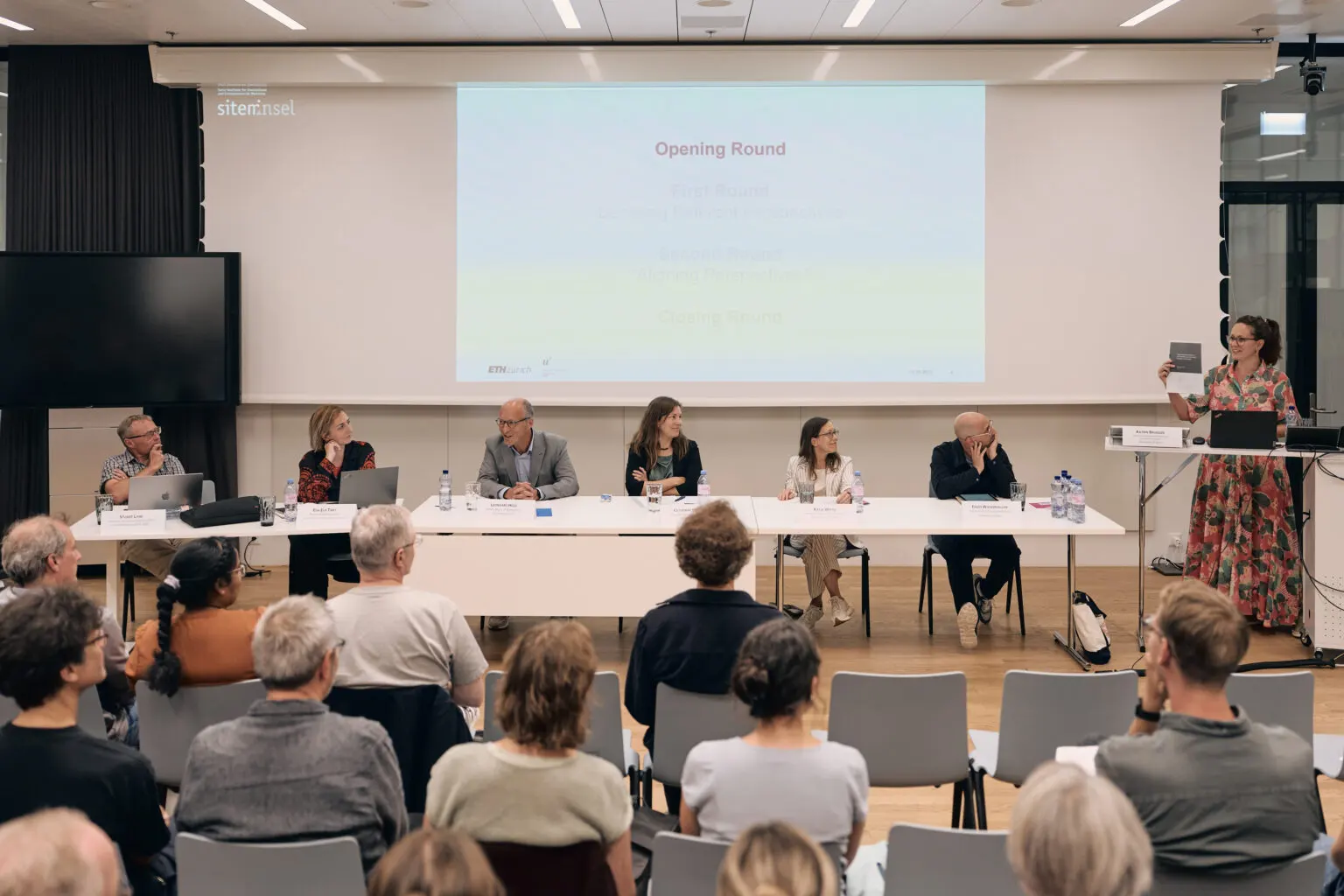
Around 40 participants attended the SYoS panel discussion at sitem-insel in Bern on 16 September 2026. Bringing together six experts from different backgrounds, the event explored key challenges and future perspectives for responsible research assessment.
This year’s SYoS panel discussion brought together experts from research, university management, research support, and funding organisations to discuss the ongoing transformation of research assessment. Katrin Brugger (Advanced Research Assessment Coordinator at the University of Graz) guided the discussion through research assessment in all its facets: of researchers in hiring, appointment, and promotion procedures; of research projects, both within universities and by national funding agencies; and of institutions as a whole. This breadth of perspectives produced a first key insight: diversity is an essential criterion for any assessment. What counts as excellence differs across disciplines and career stages, and evaluation procedures must leave evaluators enough room to account for those differences.
The researchers on the panel agreed that the DORA Declaration, published in 2012 and since endorsed by numerous Swiss universities and the SNSF, has set off many positive developments. In many fields, it prompted a substantive debate about what quantitative indicators can and cannot capture. Fabio Wasserfallen (Professor of European Politics at the University of Bern) emphasised that publications in widely cited journals do carry value: they show that researchers can address a broad audience in their field. That information cannot stand on its own, but it becomes meaningful when combined with a qualitative assessment of the publications themselves. Stuart Lane (Vice President of the SNSF and member of the Executive Board of DORA) likewise underlined that scientometrics work best when quantitative and qualitative evidence are read together. What matters with citations, for instance, is not merely their number but their substance: whether a work is cited as an example of a broader research trend or for its genuine originality and novelty. Looking beyond the numbers reveals more than the figures alone.
Eda Elif Tibet (postdoctoral researcher at the Wyss Academy for Nature and member of the Swiss Young Academy) welcomed the introduction of the Narrative CV by the SNSF in 2022 as a positive consequence of DORA. It gives researchers more room to contextualise their impact, which matters especially for social scientists, whose influence is not always measurable in high-ranking papers but also in what resists quantification: their dialogue with the public, and what they make possible for others in their field. Leonhard Held (Professor of Biostatistics at the University of Zurich) stressed that output beyond publications deserves recognition as well. In his field, researchers develop a great deal of software that can be extremely useful and should be valued accordingly. He also pointed to a practical problem in appointment procedures: the sheer number of applications often makes it impossible to do every candidate justice. A screening phase based on indicators can help reduce the pool before a serious qualitative assessment begins.
Katja Wirth (Head of the Research Promotion Service at the University of Fribourg) added the perspective of university management, underscoring how hard it is to organise reforms such as the CoARA reform across faculties. Resistance stems from different research cultures and from generational differences over how research performance should be measured. Researchers also fear that university management will force an implementation that curtails the freedom of institutes and faculties. Such reservations make it difficult to reach a university-wide consensus.
A central theme of the evening came from the audience, which wanted to learn more about AI’s role in research assessment. AI, as one participant noted, will drastically increase research output in the form of publications; a sharp rise is already visible in the proposals submitted to the SNSF. Despite this concern, Lane reported surprisingly positive feedback from evaluators in a range of settings: AI-assisted academic writing in English may reduce the “noise” created by linguistic diversity, making it easier to spot truly brilliant ideas. It can have a positive effect on diversity whether in terms of grant application or publication. Still, Lane added a caveat: how we deal with AI today is one question; how we want to shape science in the future is another. Once AI can genuinely produce original ideas, what will be the human contribution to research? Perhaps the focus will shift from producing articles to creating the environments in which research is done. Tibet likewise underscored the rupture AI represents: we are no longer assessing individual opinions, we are assessing the opinion of an entire network.
Held added that AI makes science more vulnerable to misconduct. It facilitates plagiarism, the manipulation of research data, and the mass production of inauthentic publications by paper mills. Citation counts are losing their meaning as a result, and for that very reason, he argued, maintaining trust in science is one of its essential tasks.
Finally, Catherine Brun (Deputy Head of the Sciences Team at the ETH Board) widened the frame. The question of excellence does not arise only within science. Universities must also account to their public stakeholders, and ultimately to society, for what they understand as excellence and which achievements they reward. They therefore face the challenge of reflecting that understanding in dialogue with policymakers and bringing it into alignment with their public mission. From this perspective, responsible research assessment is not only a concern for the research community itself. This suggests a starting point for future formats: carrying the debate on responsible research assessment forward amid rapid AI developments, with political decision-makers more closely involved.
The event concluded with an apéro, providing an opportunity to continue the conversations and explore ideas further.