NAIF at DARIAH Annual Event 2026
In Rome, we connected responsible research assessment with metadata quality for interoperable research infrastructures.
Dr Moritz Mähr 
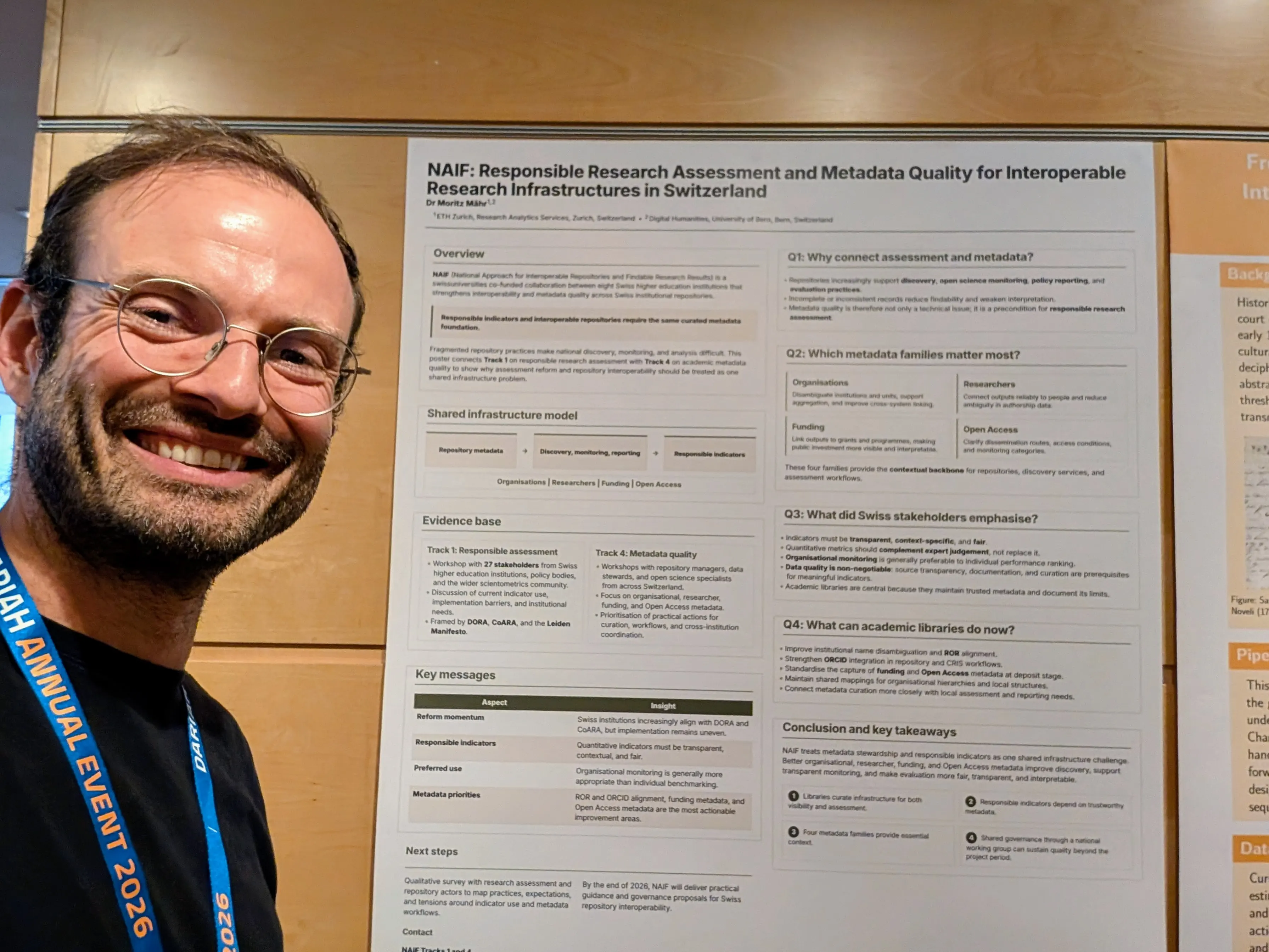
Why DARIAH mattered
From 26 to 29 May 2026, the DARIAH Annual Event brought researchers and practitioners to Rome. The event was held under the theme “Digital Arts and Humanities With and For Society: Building Infrastructures of Engagement”. It offered a useful setting for NAIF because repository interoperability, metadata quality, and responsible assessment are not only technical concerns. They shape how research becomes visible, how it can be reused, and how institutions explain the value and limits of research information.

What we presented
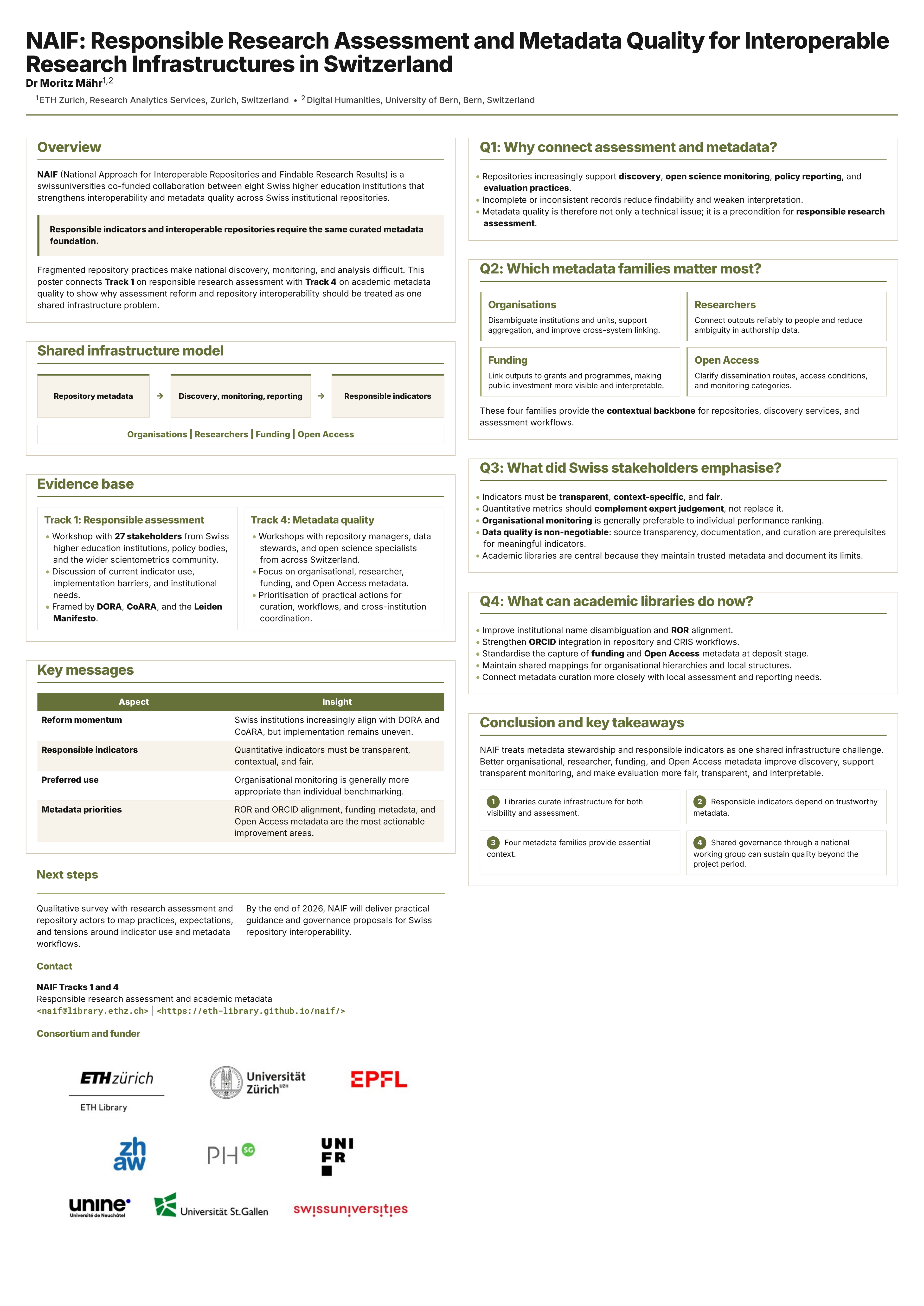
The poster NAIF: Responsible Research Assessment and Metadata Quality for Interoperable Research Infrastructures in Switzerland, presented by Dr Moritz Mähr, connected two NAIF work areas that are often discussed separately. Track 1 focuses on the responsible use of quantitative indicators in research assessment. Track 4 focuses on the enhancement and standardisation of academic metadata, especially organisational identifiers, researcher identifiers, funding metadata, and Open Access information.
Our central message was straightforward: responsible indicators and interoperable repositories require the same curated metadata foundation. Institutional repositories increasingly support discovery, open science monitoring, policy reporting, and assessment practices. If their metadata are incomplete, inconsistent, or poorly documented, both discovery and assessment become less reliable.
View the NAIF poster presented at the DARIAH Annual Event 2026
Rights: Dr Moritz Mähr, CC BY 4.0.
What we highlighted
We treated repositories as central nodes in national and international research infrastructures. They provide access to publications, datasets, and other scholarly outputs, but they also feed metadata into discovery services, open science infrastructures, and research information systems. As these metadata become part of monitoring and evaluation workflows, we must make their sources, provenance, methods, uncertainty, and limitations transparent.
For responsible research assessment, we drew on NAIF workshops with stakeholders from Swiss higher education institutions and the broader scientometrics community. Our preliminary findings emphasised that indicators must be interpreted in context, that quantitative metrics should complement expert judgement rather than replace it, and that aggregated organisational monitoring is generally more appropriate than individual-level benchmarking.
For metadata quality, we highlighted four interrelated data families:
- Organisations: disambiguating institutions and organisational units, including alignment with ROR.
- Researchers: linking outputs reliably to people through persistent identifiers such as ORCID.
- Funding: connecting outputs to grants, programmes, and public investment.
- Open Access: describing access status, dissemination routes, licences, and monitoring categories in machine-readable form.
Together, these metadata families provide the contextual backbone for repository interoperability and for the responsible interpretation of indicators derived from repository and research information systems.
Why this matters beyond Switzerland
Although NAIF works on Swiss institutional repositories, the problem is broader. Repositories are separated by institutional and technical system boundaries and often lack shared metadata standards, common interfaces, and clear governance. This makes it difficult to connect them into trustworthy research infrastructures across institutional and national contexts. These challenges are equally familiar to digital humanities, cultural heritage, open science, and research information communities.
The DARIAH context therefore helped us frame NAIF as a Swiss case study with European relevance. We showed how academic libraries and infrastructure teams contribute to engaged research by making research outputs findable, reusable, and interpretable. This work often goes unnoticed, but it is a precondition for transparent monitoring, fair assessment, and long-term visibility.
What’s next
We will continue this work through a qualitative survey with actors involved in research assessment and repository management. The survey will map institutional practices, expectations, and tensions around the use of indicators and examine how repository infrastructures and metadata workflows can better support responsible evaluation.
By the end of 2026, we will deliver practical guidance and governance proposals for Swiss repository interoperability. Our poster in Rome captures one core premise for that next phase: metadata stewardship and responsible indicators should be developed together as parts of a shared sociotechnical infrastructure.