PrePilot for data aggregation is under way
NAIF Track 2 and Track 3 are testing a structured data package with EPFL, UNIFR, and UZH.
Why it matters
In March 2026, SLiNER, in close coordination with NAIF, took a strategic decision to move forward with initial data aggregation activities. This marks a transition from conceptual discussions to practical implementation. Governance for this effort will either reside within SLiNER directly or be delegated to a dedicated working group with clearly defined responsibilities and accountability.
Within NAIF Track 2 and Track 3, and in alignment with the NAIF project lead, this decision has been translated into a concrete next step: a focused and pragmatic PrePilot for a standardised data package. The work brings together a small team from three higher education institutes: EPFL, the University of Fribourg, and the University of Zurich.
The aim is to demonstrate, through a small-scale proof of concept, that data aggregation and extraction from heterogeneous Swiss higher education repositories is technically feasible, reliable, and reproducible.
The three objectives
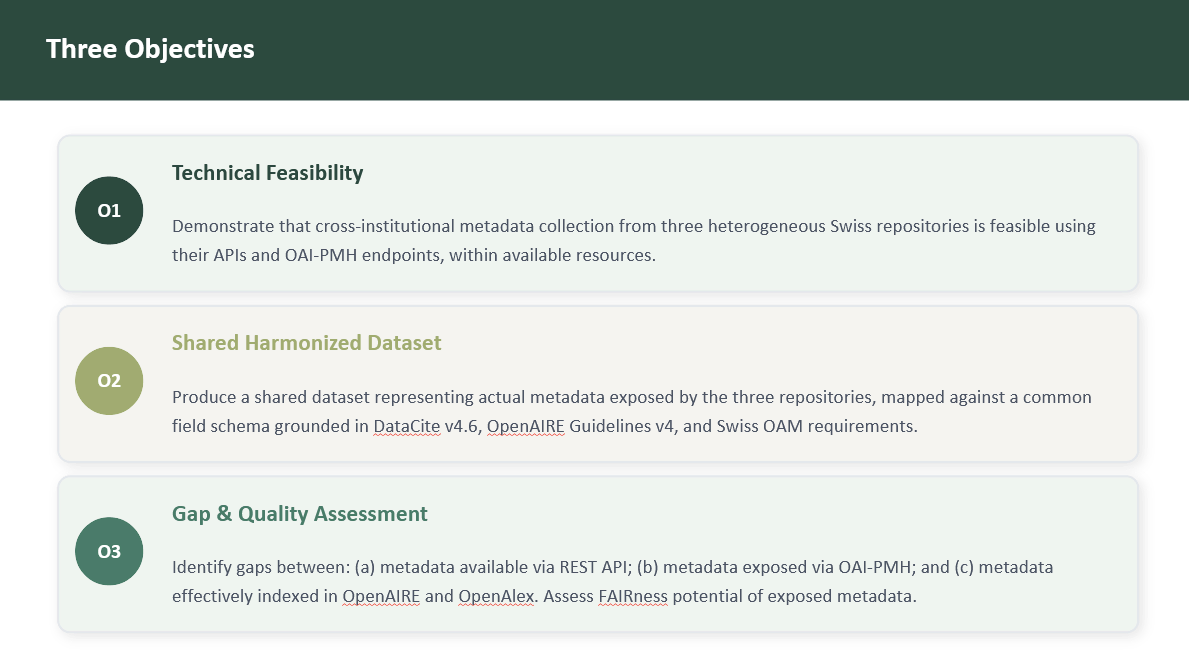
The PrePilot focuses on three objectives:
- Technical feasibility: demonstrate that cross-institutional metadata collection from three heterogeneous Swiss repositories is feasible using their APIs and OAI-PMH endpoints within available resources.
- Shared harmonised dataset: produce a shared dataset representing actual metadata exposed by the three repositories, mapped against a common field schema grounded in DataCite 4.6, OpenAIRE Guidelines 4, and Swiss Open Access Monitor (OAM) requirements.
- Gap and quality assessment: identify gaps between metadata available via REST APIs, metadata exposed via OAI-PMH, and metadata effectively indexed in OpenAIRE and OpenAlex, including an assessment of the FAIRness potential of exposed metadata.
How the working group proceeds
The working group has initiated and planned the PrePilot as a focused, reproducible process that does not require cloud infrastructure or proprietary tools.
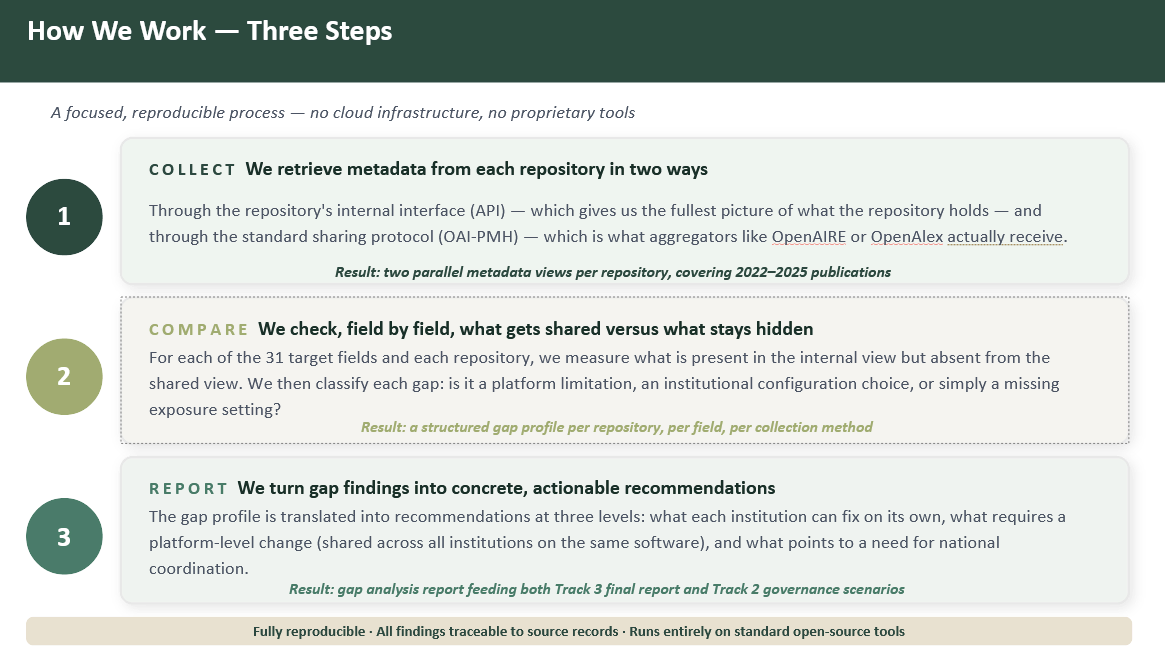
The workflow consists of three steps:
- Collect: retrieve metadata from each repository through the repository’s internal interface, such as an API, and through the standard sharing protocol OAI-PMH.
- Compare: check field by field what is shared and what remains hidden, then classify each gap as a platform limitation, institutional configuration choice, or missing exposure setting.
- Report: translate the findings into concrete recommendations for individual institutions, shared platform-level improvements, and areas that require national coordination.
What’s next
The setup is complete. The next steps are field mapping, data collection, alignment, and finally a gap analysis report. The working group plans to complete the final result by the end of November 2026.
The PrePilot is a collaborative effort by NAIF Track 2 and Track 3. The working group consists of Pascale Bouton, Julien Sicot, and Jorge Rodrigues de Matos from EPFL for Track 3; Andrea Malits, Martin Brändle, and Stefan Vogt from the University of Zurich for Track 2; and Thomas Henkel from the University of Fribourg as coordinator for UNIFR and working group member.