How NAIF builds on TOBI’s results in Switzerland
From evidence on open scholarly data to coordinated implementation.
Dr Moritz Mähr 
Why it matters
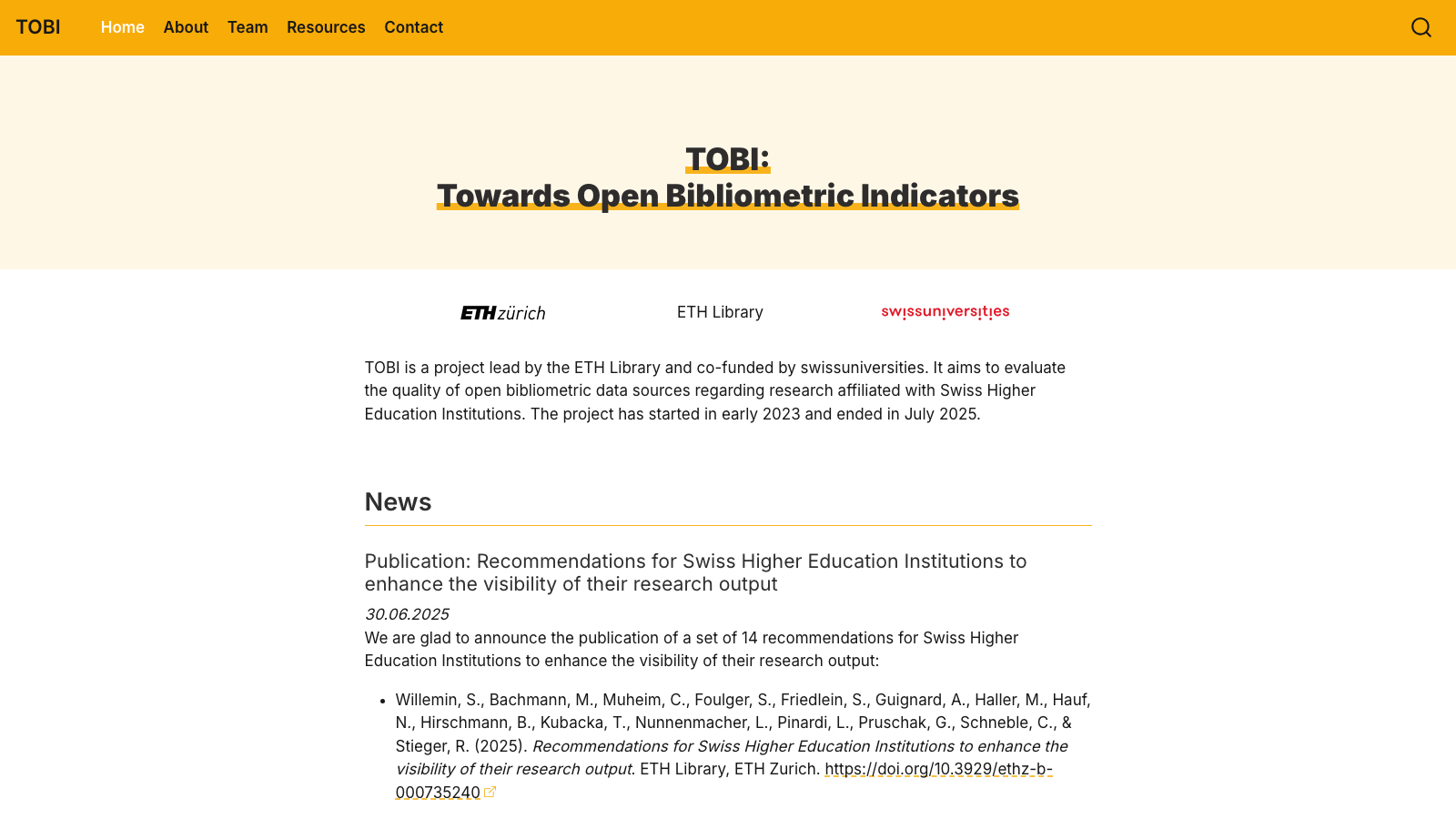
TOBI (Towards Open Bibliometric Indicators) closed in July 2025 having established an important premise: despite its name, the project focused primarily on the quality, coverage, and usability of open scholarly data rather than on promoting indicators as an end in themselves. Data quality is not a technical afterthought, but a fundamental prerequisite for credible analyses and fair representation.
NAIF continues from that same premise, but places it in a wider interoperability context. Within NAIF, the data quality conditions evaluated by TOBI become operational requirements across Swiss repositories, directly ensuring the findability and visibility of Swiss research.
View the interactive TOBI data dashboard here: TOBI Data Dashboard.
What we did
TOBI delivered comparative analyses, methods, tools, and curation work that can be reused by Swiss institutions. Using open science principles aligned with CoARA, it evaluated data provenance and methodological openness across open and commercial databases.
Building on these foundations, NAIF continues TOBI’s focus in Track 3 and Track 4 by actively assessing the availability and quality of metadata in Swiss repositories and prioritising concrete improvement actions.
What we found
TOBI’s analyses showed that coverage and metadata quality differ substantially across institution types and sizes in Switzerland. Key recurring issues remain: inconsistent organisation names, incomplete affiliation links, and uneven completeness of metadata across systems.
The evidence clearly demonstrates that findability depends on disambiguation and consistent identifiers. Consequently, NAIF’s conceptual work is based on the realisation that we must move away from diagnosing identifier problems in external databases towards supporting local and national processes that prevent these problems at source.
What’s next
While TOBI primarily answered how reliable open bibliometric sources are for Swiss Higher Education Institutions, NAIF asks: How do Swiss repositories and stakeholders coordinate these improvements so that national findability and interoperability become durable rather than project-bound?
The key shift is from evidence generation to implementation design: defining what data needs to be updated, who does it, which systems and standards are used, and what kinds of feedback loops are needed.
Moving forward, NAIF will maintain a strong analytical distinction between data readiness and indicator interpretation to determine what conditions must be met before indicators are compared. Findings from the four NAIF tracks are designed to feed into a national working-group model that will ensure sustained coordination beyond the project period.
What to reuse
TOBI delivered reusable assets, including publications, datasets, code resources, practical recommendations, and curated affiliation data. NAIF continues this reuse-first approach through workshops, cross-institution dialogue, and openly shared deliverables. Key resources carrying persistent identifiers include:
- Kubacka, T., & Willemin, S. (2023). Evaluating the quality and reliability of open bibliometric data for country-wide research assessment purposes in Switzerland. DOI: 10.5281/zenodo.10041143
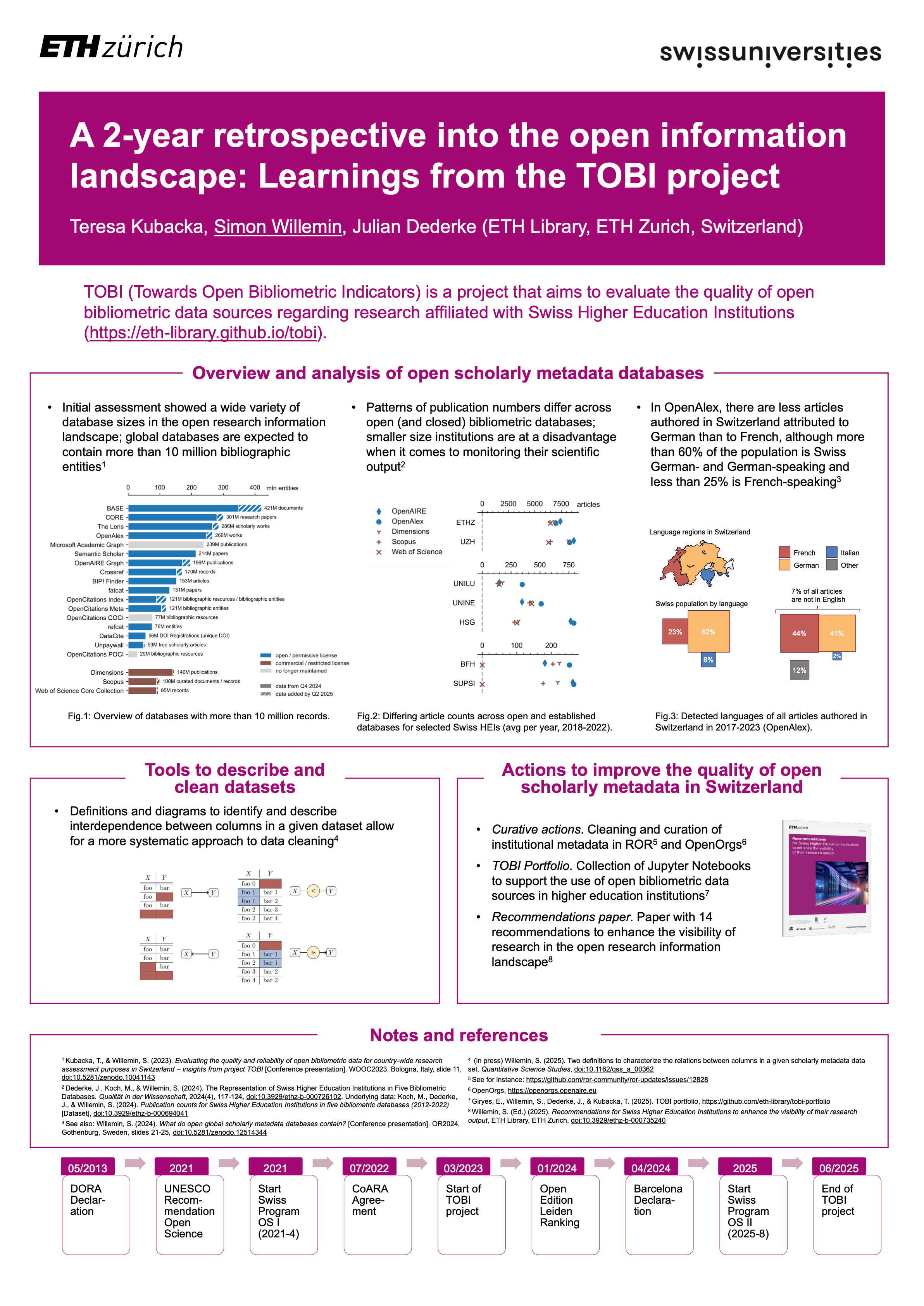
- Kubacka, T., Willemin, S., & Dederke, J. (2025). A 2-year retrospective into the open information landscape: Learnings from the TOBI project (poster). DOI: 10.5281/zenodo.15807578
- Dederke, J., Koch, M., & Willemin, S. (2024). The Representation of Swiss Higher Education Institutions in Five Bibliometric Databases. DOI: 10.3929/ethz-b-000726102
- Willemin, S. (2025). Two definitions to characterize the relations between columns in a given scholarly metadata data set. DOI: 10.1162/qss_a_00362
- Willemin, S. (Ed.). (2025). Recommendations for Swiss Higher Education Institutions to enhance the visibility of their research output. DOI: 10.3929/ethz-b-000735240
Sources
- TOBI project homepage: https://eth-library.github.io/tobi/